
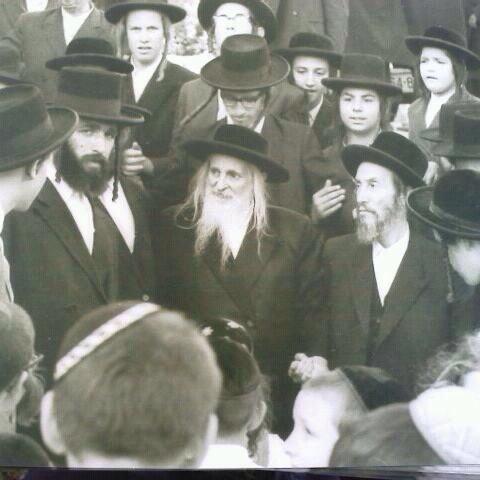
The Satmar Rebbe was renowned for expressing profound gratitude to anyone who had ever done him a favor, regardless of how small. He retained feelings of appreciation for such individuals and for their children for the rest of his life. This was especially true of those who had assisted him during the war, regardless of whether they were religious or secular, Jewish or gentile. For many years after the war, he sent them gifts and sought to assist them in any way he could.
For example, the Rebbe sent an emissary to thank Dr. Joseph Fischer, through whose efforts he was included in the transport. He was grateful to the Salvadoran ambassador to Hungary for working toward his release. He also expressed his appreciation to Dr. Schwartz and Dr. Klein, who assisted him with his health problems in the Bergen Belsen camp. This was in addition to the Rebbe’s lifelong gratitude to the many supporters in the religious community who helped him throughout every stage of the escape and paid enormous sums toward his release.
It is therefore false to attribute to the Rebbe the view that, because his escape had been orchestrated by Divine Providence, he was not obligated to repay the kindness of the human beings who had served as G d’s agents in saving him.
Kastner, however, was a different matter. Certainly, the Rebbe would not have testified in a court of the Zionist state, which he refused to recognize. It may be assumed that, in this respect, he shared the position of his close colleague, Rabbi Michael Ber Weissmandl, who was asked to testify in the Kastner trial but refused because he “did not recognize a secular Jewish court.”
Nevertheless, the Rebbe could have shown appreciation to Kastner in other ways, or spoken publicly in his defense. Why did he not do so?
The Origins of the Rescue Plan
The plan to bribe the Nazis to release Jews from occupied territories did not originate with Kastner and his fellow Zionists in Hungary. It began with Rabbi Michael Ber Weissmandl in Bratislava, Slovakia. By paying the Nazi officer Dieter Wisliceny a total of $50,000 in bribes, Rabbi Weissmandl was able to delay the deportation of 30,000 Slovakian Jews for two full years.
After witnessing this success, Rabbi Weissmandl began developing a broader plan to save the remaining Jews of Europe. Negotiations concerning what became known as the Europa Plan continued after the Nazis occupied Hungary in March 1944. On Rabbi Weissmandl’s advice, Wisliceny began discussing the plan with Pinchus Freudiger, head of the Orthodox community in Budapest. The Nazi proposal was to release approximately one million Hungarian Jews in exchange for $12 million.
This extraordinary rescue might have taken place had the Zionists in Budapest not sabotaged the effort in order to assume control of the rescue committee themselves. Rudolf Kastner and Joel Brand became the new leaders of the rescue effort.
According to Rabbi Weissmandl in his book Min Hameitzar, the Zionist takeover was a misfortune because, in his view, the Zionist party was not primarily interested in saving Jews generally. Rather, he claimed, its priority was to save its own leaders and party members so that they could go to Palestine and assist in establishing a Jewish state.
Eichmann, the Nazi official in charge of the destruction of Hungarian Jewry, sent Joel Brand as an emissary to the Zionist leadership in Istanbul with a request for “trucks for blood.” The Nazis offered to spare one million Jews in exchange for 1,000 tons of tea, 1,000 tons of coffee, and 10,000 trucks.
Moshe Sharet, Yitzchok Greenbaum, and other leaders of the Zionist Agency, however, decided that efforts to save these Jews would be undesirable because they might displease their British allies and interfere with their plans for a Jewish state in the Holy Land. They therefore decided to conceal Brand’s mission. He was lured across the border from Turkey into Syria, after which the British took him to a prison in Egypt. He remained there for months, his message undelivered, until most of the Jews of Hungary had been gassed and burned in Auschwitz.
The Kastner Transport
After the failure of the broader plan to save Hungarian Jewry, Kastner was able to obtain from Eichmann only an offer to release a limited number of Jews selected by Kastner, in exchange for bribes and Kastner’s silence.
In 1960, an interview with Eichmann conducted by the Dutch Nazi journalist Willem Sassen in Argentina was published in Life magazine. In the interview, Eichmann stated that Kastner “agreed to help keep the Jews from resisting deportation and even keep order in the collection camps if I would close my eyes and let a few hundred or a few thousand young Jews emigrate to Palestine. It was a good bargain.”
By the beginning of May 1944, Kastner and many other Jewish leaders had received the Vrba Wetzler Report, compiled by two escapees from Auschwitz, along with other evidence indicating that Hungary’s Jews were being sent to their deaths. The report was distributed to Jewish organizational leaders in the hope that Hungarian Jews would be warned that they were being deported to a death camp rather than resettled, as they had been led to believe.
However, the report was not made public by the Jewish Council in Hungary or by Kastner. It was Kastner’s Jewish Agency rival, Krausz, who eventually sent the report to Switzerland for publication. The resulting international outcry persuaded the Hungarian government to halt the deportations. By that time, however, 437,000 Hungarian Jews had already been deported to Auschwitz, where the overwhelming majority were murdered upon arrival.
At his own trial, Kastner testified that his primary concern had been “that most of the Zionist leadership should leave Budapest with the transport.” Even the 1,684 Jews who ultimately boarded the transport were released only through the payment of enormous sums of money and valuable objects, collected by the Jewish communities of Hungary, primarily by the Orthodox community in Budapest.
The fact that much of the money had come from Orthodox Jews was the main reason Kastner was compelled to include several Orthodox rabbis on the list, most notably the Satmar Rebbe. The Orthodox activist Chaim Roth personally paid a substantial sum for the Rebbe’s place. Rabbi Yonasan Steiff and Rabbi Shlomo Tzvi Strasser were also included.
Despite the money paid on his behalf, Kastner initially refused to save the Satmar Rebbe, knowing that he was an opponent of the Zionist party. He agreed to do so only at the insistence of his father in law, Dr. Joseph Fischer, head of the Jewish Council of Cluj, also known as Klausenberg.
Later, after they had reached freedom in Switzerland, Dr. Fischer approached the Rebbe and said:
“I am sure the Rebbe understands that we did not plan to include him on the list of the privileged. Everyone knows that the Satmar Rebbe is a sworn enemy of the Zionists. But I will tell you the truth. One night in Klausenberg, my mother came to me in a dream and warned me to make sure to include the Satmar Rebbe on the list and only then would there be hope that all the people could escape.”
When the Rebbe related this story years later, he noted that Fischer’s mother had been a religious woman who covered her hair and observed the commandments of the Torah, while his father had been a Torah scholar. She was the aunt of Rabbi Yisroel Yaakov Fischer, who later became a member of Jerusalem’s anti Zionist religious court.
The Journey to Bergen Belsen
At every stage of the journey from Budapest to the Swiss border, it was not Kastner but the Rebbe and his followers who ensured the success of the rescue effort.
The train was stopped for two days at the Austrian border. It was then sent in the opposite direction before being stopped again in the middle of nowhere. The passengers disembarked and sat on the ground beside the railway cars. When some of them asked the driver where they were being taken, he replied, “Auschwitz.”
Panic seized the passengers, who began searching for a way to notify the rescue committee in Budapest. The Rebbe arranged for a Jewish girl who did not appear Jewish to travel to Budapest and inform Chaim Roth. Roth, together with Kastner, ran to Eichmann and protested that they had been betrayed.
Eichmann smiled and replied calmly:
“It seems there was a mistake. We ordered the train sent to a camp in Auschpitz, in the Sudetenland. Someone wrote Auschwitz instead. Do not worry. If they go to Auschwitz, I will give you another train.”
Roth protested that he had paid a large sum to save a certain great rabbi who was on the train. Eichmann answered:
“Listen, this was not my mistake. But if you bring me more money, I will try to correct it.”
Roth brought another substantial bribe. Only then was the train turned around and sent to Bergen Belsen, where the passengers were held for five months while the Nazis waited for additional money from Jews in the free world.
Alerting the Free World
How did the Jews of the free world learn of the passengers’ plight?
When the train stopped in Bratislava, Slovakia, the Rebbe spoke with local Jews and asked them to spread the news of their predicament. Shlomo Gefen, one of the Rebbe’s followers, wrote to his brother in law, Moshe Gross, in Switzerland. Gross notified the Orthodox rescue committee in Switzerland, led by Yitzchok Sternbuch, who circulated the news throughout the world.
Orthodox Jews in America then appealed to the War Refugee Board in Washington. Rabbi Michael Weissmandl in Slovakia and his fellow rescue workers continued to alert the world to the danger facing the transport until the money demanded by the Nazis was finally collected.
The Joint Distribution Committee had the necessary funds, and it would not have been difficult to obtain the trucks demanded by the Nazis. The only obstacle was Dr. Solly Mayer, head of the Joint in Switzerland. He refused to use any money to purchase trucks for the Germans, arguing that the SS was using the proposal as a ploy to drive a wedge between the Allied nations fighting Germany.
According to Mayer, Germany would ensure that the Russians learned that America and England were supplying the Germans with trucks to use against Russia. Mayer also refused to allocate funds to free the prisoners in Bergen Belsen. Even Kastner reportedly could not understand Mayer’s position.
Ultimately, the Jews of Budapest, together with Yitzchok Sternbuch in Switzerland, raised enough money to purchase 30 trucks from Switzerland. When Mayer learned of this, he became angry and threatened to cut off the Joint’s support for Budapest.
Freedom at the Border
The refugees were released from Bergen Belsen in December 1944 and placed on a train bound for Switzerland. In the middle of the night, however, near the Swiss border in Austria, the train suddenly stopped. It remained stationary for an extended period, and the passengers began to worry.
Then someone entered the train and ordered everyone to take their belongings and disembark. The passengers’ fears intensified. They had been prepared to step onto free soil within a short time, but now the Germans were once again issuing orders.
Their fears were not unfounded. A rumor began to spread that an order had just arrived from Himmler in Berlin instructing that the train to Switzerland be stopped and sent to Auschwitz.
Meanwhile, back in Budapest, SS Colonel Kurt Becher continued to insist that the full payment had not been received. The Nazis demanded $1,684,000 for the 1,684 Jews. According to Becher, $64,000 remained unpaid. He claimed to have received orders that, unless the money was delivered, the train would be turned around and sent to Auschwitz.
Once again, Solly Mayer refused to provide the funds.
The train remained at the border, its passengers uncertain whether they would live or die. Then Rabbi Leibush Rubinfeld of Switzerland came to their rescue. He brought a sum of money and bribed Hermann Krumey and the other SS officer accompanying the train.
Krumey quickly ordered the passengers to collect their belongings and board the train to Switzerland. The two Nazi officers even helped place the passengers’ belongings on the train. They then sent a telegram to Berlin stating that Himmler’s order had arrived too late: the train had already reached the Swiss side of the border, and the order could no longer be carried out.
Throughout this remarkable story, the religious Jews, not Kastner and the Zionists, served as G d’s agents in saving the Satmar Rebbe and the other Jews on the transport. Divine Providence preserved the Rebbe so that he could rebuild and illuminate the Jewish world after the destruction of European Jewry.